


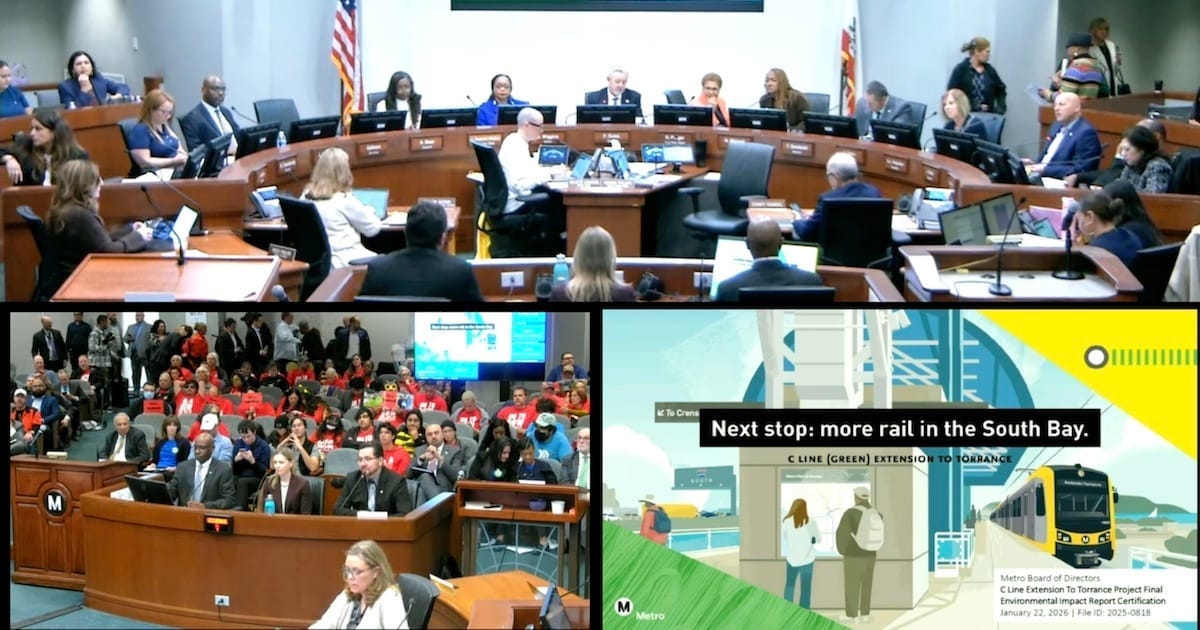
Yesterday the Metro board made two awful, cowardly decisions that cast serious doubts on their ability to lead an agency undertaking the largest public transportation expansion in the country. First, they voted to ask for LA County to be exempt from SB 79, the transit-oriented upzoning law that would allow more homes to be built near Metro’s own train stations and bus stops. Then, over Metro staff’s objections, they voted to change the route of the planned South Bay extension of the K Line train, choosing the more expensive, less feasible route and throwing the entire future of the project in doubt. As we’ll see, the common thread in these votes was simple: caving to NIMBYs.
No SB79 in my backyard
Why would Metro want to kill the law that will let more people live near the transit Metro builds? Wouldn’t they want more people to, you know, use their product? The problem, as Metro sees it, is that the law makes their job harder. SB 79 allows upzoning around future transit lines if they’d already reached a certain stage of planning when the law passed. For example, SB 79 applies to the areas around the stations on the future subway through the Sepulveda pass even though it’s years away from construction.
You can see where this is going. NIMBYs around future Metro stations will fight to keep the line from being built so that their neighborhoods don’t get upzoned. This is already happening in Glendale with the under construction North Hollywood to Pasadena bus rapid transit project. Glendale officials, including Mayor Ara Najarian, are vowing to stop the project in their city so they don’t have to face a NIMBY backlash when the areas around the bus stops get upzoned.
Metro’s reaction to this? Waaaaah! Metro staff’s report cranks up the whining to 10:
SB 79 has become a catalyst for local opposition to Metro’s transit projects. By linking increased housing density to both existing and future transit investments, the law has intensified resistance from some cities and community groups that now view new transit projects as a trigger for state-mandated upzoning.
Sure, the resistance has “intensified”. But it’s not like Metro’s projects were just sailing through before unscathed. Just look at the NoHo-Pasadena BRT project. NIMBYs showed up in droves to oppose it at the initial community meetings. An LA City Councilmember stalled it. The project was saved only when a group of community activists proposed their own plan, which Metro largely adopted.
Metro always faces intense pushback, including lawsuits, from grumps who oppose their projects. And yes, SB 79 gives NIMBYs another thing to be afraid of. Ara Najarian supported the BRT before the law passed - that’s certainly a headache for Metro. But getting rid of SB 79 would not stop local resistance. NIMBYs will always, always find reasons to oppose projects.
If Metro is having trouble because the Najarians of the world are stalling construction, they should get state legislators to pass permitting reform so local elected officials don’t have the power to block regional transportation projects from getting built. But the problem is that the Metro board is made up almost entirely of local elected officials from across LA County - mayors, city councilmembers, county supervisors. Serving on the Metro board is just their other part-time gig. Karen Bass is on the Metro board. Notorious NIMBY city councilmember Imelda Padilla is on the Metro board. Ara Najarian is on the Metro board! These folks would never ask the state to take away the power they have in their day jobs to stall projects their constituents don’t like.
And of course, local electeds hate SB 79 itself because it takes away their control over zoning in their city. Most of the Metro boardmembers are on the record opposing SB 79. Naturally they seized this opportunity to beg for an opt-out for LA County.
What is lacking in this story is the kind of vision or leadership we should expect from the Metro board. SB 79 will eventually lead to millions more people living near the transit Metro builds. This short-sighted attempt to get around the law, while possibly making it a little easier to build projects, would only harm Metro and LA in the long term. The anonymous Mar Vista Voice put it best:
If Los Angeles is exempted from SB 79, the consequences will be clear. Metro will continue building expensive infrastructure through low-density neighborhoods while ridership lags, housing costs soar, and access to homes near transit remains scarce. That is not a transit success story. It is the status quo, reinforced.
SB 79 is a generational opportunity to fix LA’s outdated zoning and build a city that works for everyone, not just rich homeowners. It also will lead to huge ridership gains for Metro. In a sane world, Metro would embrace the law and work with the state to improve it. In a sane world, the Metro board would push back against staff’s whining about NIMBYs and remind them what a boon the law is for the agency. Instead, all the mayors and councilmembers on the board can think about is the small ball of appeasing their constituents, even if it means throwing the baby out with the bathwater at the expense of every Angeleno and Metro itself.
South Bay rail likely killed
The request to exempt LA County from SB 79 wasn’t even the worst decision the Metro board made yesterday. For over a decade, Metro has been in the process of planning an extension of its suburban South Bay light rail line from Redondo Beach to Torrance. Like all Metro projects, this one generated NIMBY pushback from the start. But in 2024, over homeowner objections, the Metro board approved the best route, in blue and orange below. Known as the “hybrid alternative”, the route uses an existing right-of-way that Metro already owns and that already has tracks used by freight trains (the tracks would be moved over to make space for the new light rail tracks).
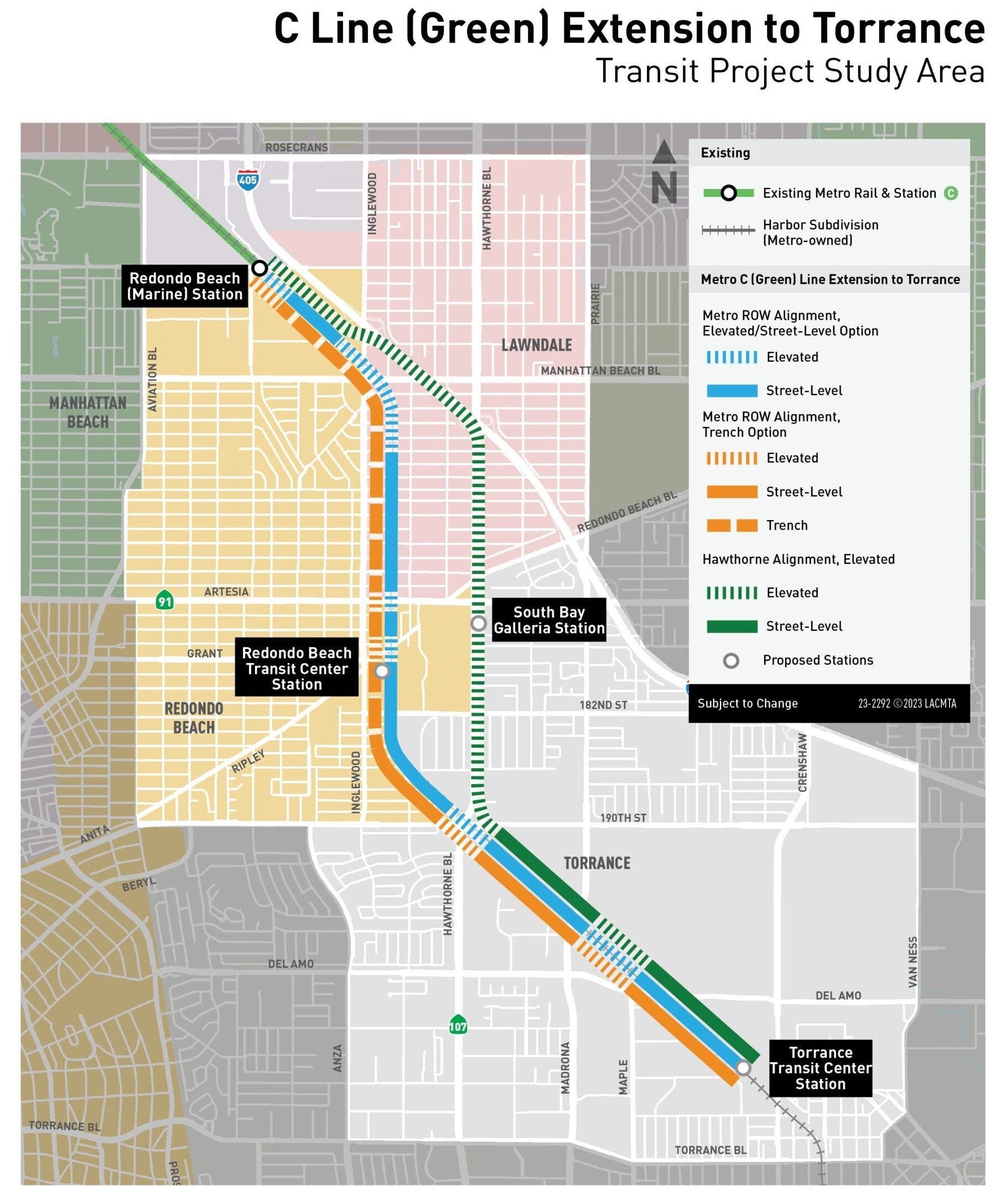
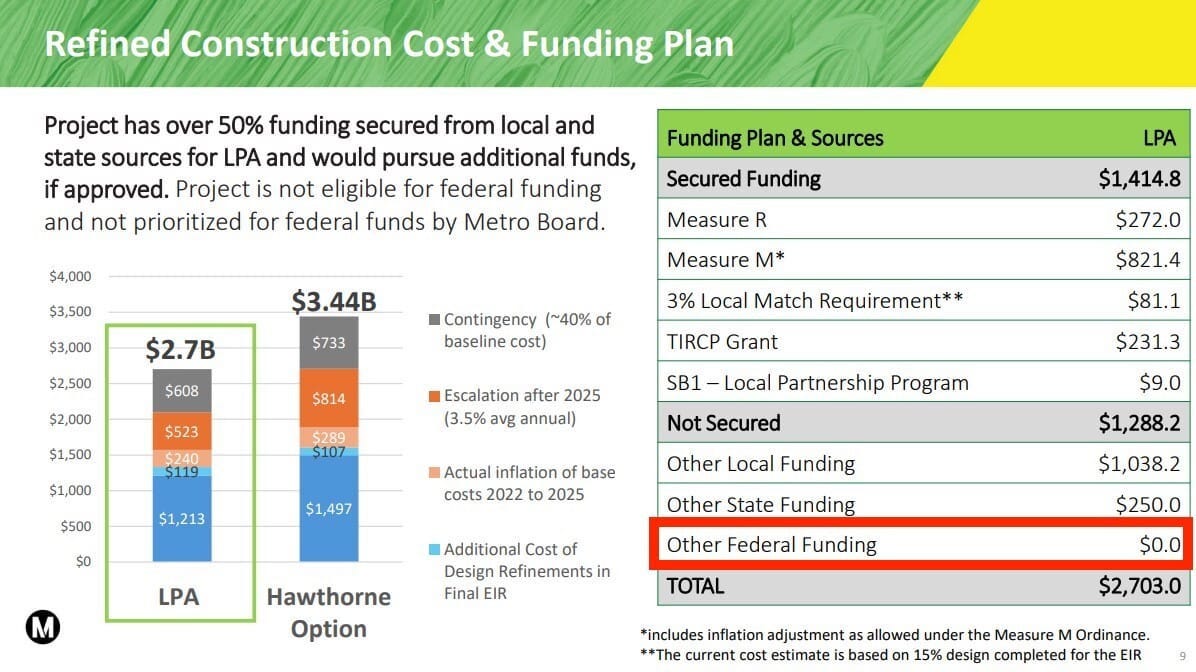
The hybrid alternative has two big advantages over the other route down Hawthorne Blvd., in green. One is cost - the hybrid route, shown below as LPA for “locally preferred alternative”, costs $737 million less than the Hawthorne route, and it crucially requires zero federal funding (unavailable until Democrats regain power). The other advantage is feasibility - the Hawthorne route runs parallel to the 405 freeway for a stretch, crossing over off-ramps and running next to a sound wall. This “encroachment” would trigger added layers of complexity for the project, including several years of federal environmental review and uncertain approvals from Caltrans, which would lose the ability to widen the 405 next to the train.
After the Metro board picked the hybrid route in 2024, staff compiled their final environmental report, which the board was supposed to certify yesterday. Instead, County Supervisor Holly Mitchell, who serves on the Metro board and whose district the project runs through, filed a surprise last-minute motion to switch the route to Hawthorne. At yesterday’s meeting, the board voted unanimously for the Hawthorne route.
I talked to Nick Andert, who has become semi-famous among LA urbanists for his incredibly in-depth videos about Metro’s future transit lines. Andert told me this decision likely sets the project back 5-10 years and could possibly kill it altogether. Besides requiring years more of environmental studies, Hawthorne’s biggest problem is that $737 million difference - it will need more funding. But it’s a low ridership, suburban project that is unlikely to win federal or state grants, especially when Metro has more important projects that will be competing for the same funds. It may never get fully funded.
It’s also quite possible that Caltrans will simply veto the project. Caltrans already killed Metro’s plans to extend the E Line along the 60 freeway, and there’s no reason to think they’ll be any more amenable to a train running next to the 405, especially when they can argue that there’s a perfectly good alternative route that avoids the freeway.
The problem with endangering this four-mile extension is that it endangers Metro’s entire long-term vision for transit in the South Bay, which is to eventually extend the train all the way to San Pedro or Long Beach for a one-seat ride to LAX and points north. Andert points out the echoes of former congressman Henry Waxman, who blocked the subway under Wilshire in the 1980’s, a mistake finally being rectified this year:
Why did this happen? NIMBYs. The hybrid route follows freight train tracks close to the homes of some residents of Lawndale and Redondo Beach who used the language of environmental justice to argue that Metro was taking away their “greenbelt”. Never mind that freight trains already run on the existing tracks. Never mind that Metro was planning to spruce up the green space, adding more trees and building a proper walk and bike path. These homeowners just didn’t want the transit. Their sustained campaign won over Holly Mitchell, who in her day job as County Supervisor counts these homeowners as her constituents. The rest of the board went along with Mitchell out of deference since it’s her “home” project.
Again, what we are lacking here is the vision and leadership we should expect from the Metro board. Holly Mitchell has potentially killed light rail for most of the South Bay because of the objections of a few homeowners who might not have voted for her if they were mad at her. The board made a short-sighted, political decision that will harm Metro and the South Bay in the long term.
Bat signal to Sacramento
The Metro board needs reform. It needs fewer politicians who care mostly about their constituents and more experts who care mostly about transit. Fewer people who are as out of touch as Karen Bass, who marveled at yesterday’s meeting that Angelenos would actually advocate for transit:
It’s really exciting to see a generation of young people who are in the fight very seriously for public transportation. It used to be a phenomenon in LA, I mean, you were almost born with a car, and I always was amazed by my friends in New York who never learned to drive. That was just out of our experience.
Let’s get people on the Metro board who actually use transit. Who like transit. Who love cities and want them to work. Look at who’s on the board of WMATA, the Metro of Washington, DC:
Senior urban development specialist with the World Bank
Maryland’s Assistant Transportation Secretary for Planning and Project Development
Fairfax County, Virginia supervisor
Fellow at Brookings Metro, studying commercial real estate, infrastructure, racial justice, and governance
Associate Director of Maryland Government Affairs for Johns Hopkins University
Group Vice President of Maritime Policy and Government Affairs at MSC Group
These look like serious people. They are appointed by elected officials. They are mostly not elected officials themselves.
As it happens, the state legislature decides how Metro’s board is structured, and Sacramento will need to make changes before 2030. That’s because of Measure G, an LA County ballot measure we passed in 2024 that expands the number of LA County Supervisors from five to nine in 2030. Currently, all five county supervisors sit on the 13-member Metro Board, but Sacramento gets to decide what happens when the supervisors expand to nine.
LA is blessed with a Metro that, thanks to several voter-passed sales tax hikes, is well-funded and has big plans for our future. The fully built-out network is a functional, usable, and dare I say transformational public transit system.
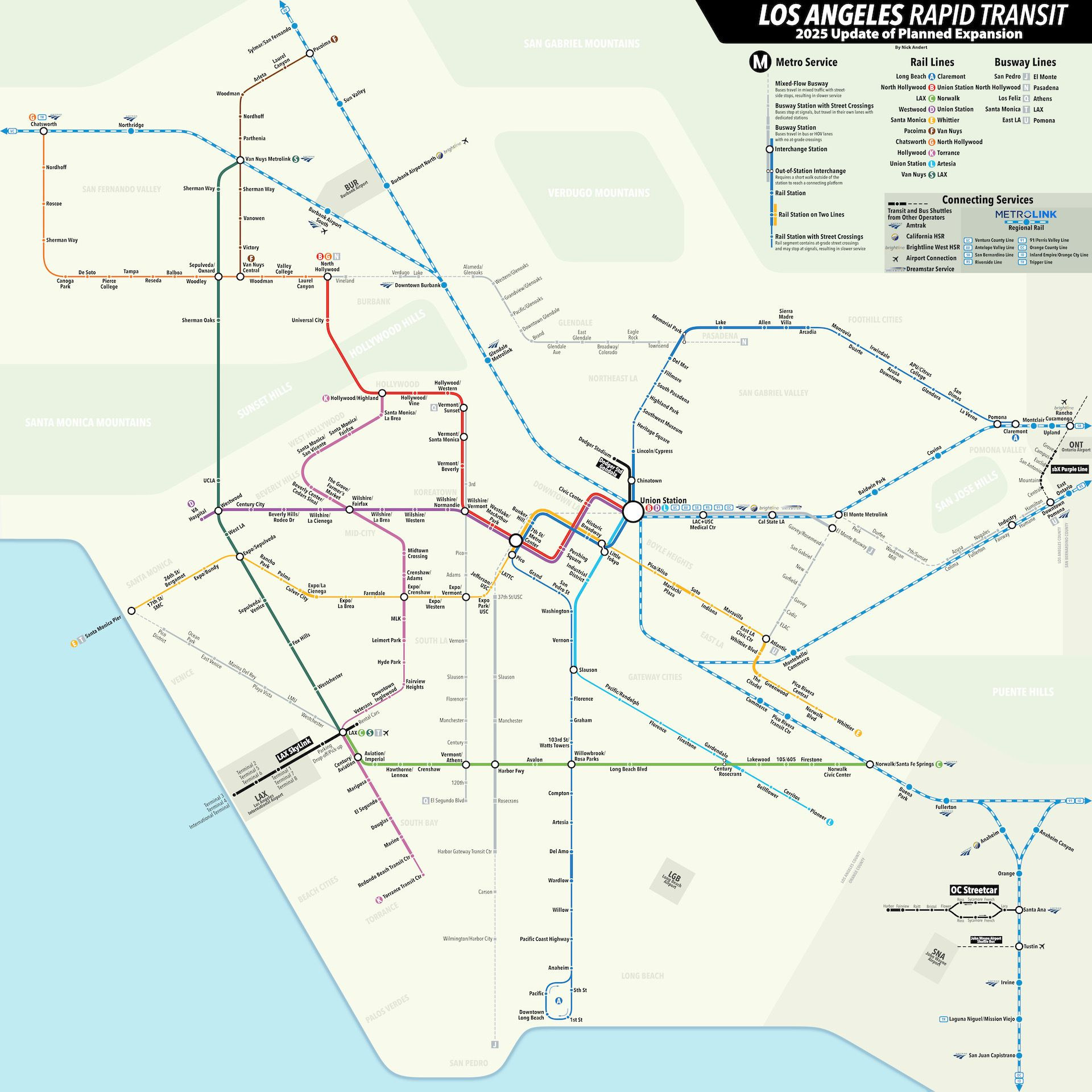
This is a huge, decades-long, $100 billion undertaking. For Metro to succeed, it needs better governance. Better leadership. Yesterday.