



In March, local and state officials gathered to celebrate the groundbreaking of a remarkable building dubbed Sky Village Hollywood - 35-stories with over 500 apartments, every one of them reserved for low- and moderate-income renters. California State Controller Malia Cohen told the crowd, “We are actually taking a pause in the craziness of the world and acknowledging how much hope building a home will bring to people.”
LA County Supervisor Lindsey Horvath had a blunter assessment: “We need more projects like this.”
Missing from the event was someone who could claim much of the credit for getting this building built - Mayor Karen Bass, whose Executive Directive 1 expedited the approvals for Sky Village Hollywood and over 450 other 100% affordable buildings.
The Mayor issued ED 1 the week she was inaugurated, and it is the housing policy she talks about the most. The order exempted affordable housing projects from public hearings, appeals, and environmental reviews, and it directed city departments to approve them within 60 days. The Mayor is right to be proud - from the start, ED 1 accomplished something truly remarkable and surprising. It supercharged a fledgling sector of LA’s housing market: privately funded affordable housing. After the Mayor issued her order, a flood of developers proposed building 100% affordable projects with no public subsidy. ED 1 made building affordable housing profitable.
In the ensuing 3½ years, however, the program has gotten mired in controversy after controversy, and for many the shine has come off the apple. Ask housing activists, and you’ll get all kinds of opinions. It’s a huge success! No, the Mayor killed it! Actually, it’ll last forever! But nothing’s getting built!
I decided to dig into the data to figure out the true legacy of ED 1. What I found surprised me, and hopefully will surprise you too.
Most ED 1 projects are likely to get built
ED 1 has been a smashing success on paper, with over 35,000 income-restricted homes approved by the Planning Department. But approved doesn’t mean built, and what works on a spreadsheet doesn’t necessarily translate to shovels in the ground. Especially with an unproven business model - privately funded affordable housing - the question with ED 1 has always been whether the buildings would actually get built.
Well, here’s some good news. As of this week, 118 ED 1 buildings with a total of 8,519 apartments have pulled permits for construction, and nine have opened.1 That means 26% of approved ED 1 projects have broken ground. Wait, is that good? Let’s look just at buildings approved in 2023, ED 1’s first year - they’ve had three years to go through the plan check process and pull permits. Fully 58% of ED 1 projects approved in 2023 have broken ground. That’s a much higher percentage than non-ED 1 apartment buildings approved in the city that year, only 42% of which have broken ground.2
If you’re disappointed that only a quarter of approved ED 1 buildings have started construction so far, you can blame LA’s notoriously slow plan check process. Remember that 60 day shot clock for approving projects? It only applies to the Planning Dept. The next step after Planning approval is review by the Dept. of Building and Safety, and the average time for ED 1 projects to complete their LADBS plan check is 642 days, or over 21 months. Projects approved by the Planning Dept. in 2024, the peak year of ED 1, have just started to break ground this year.
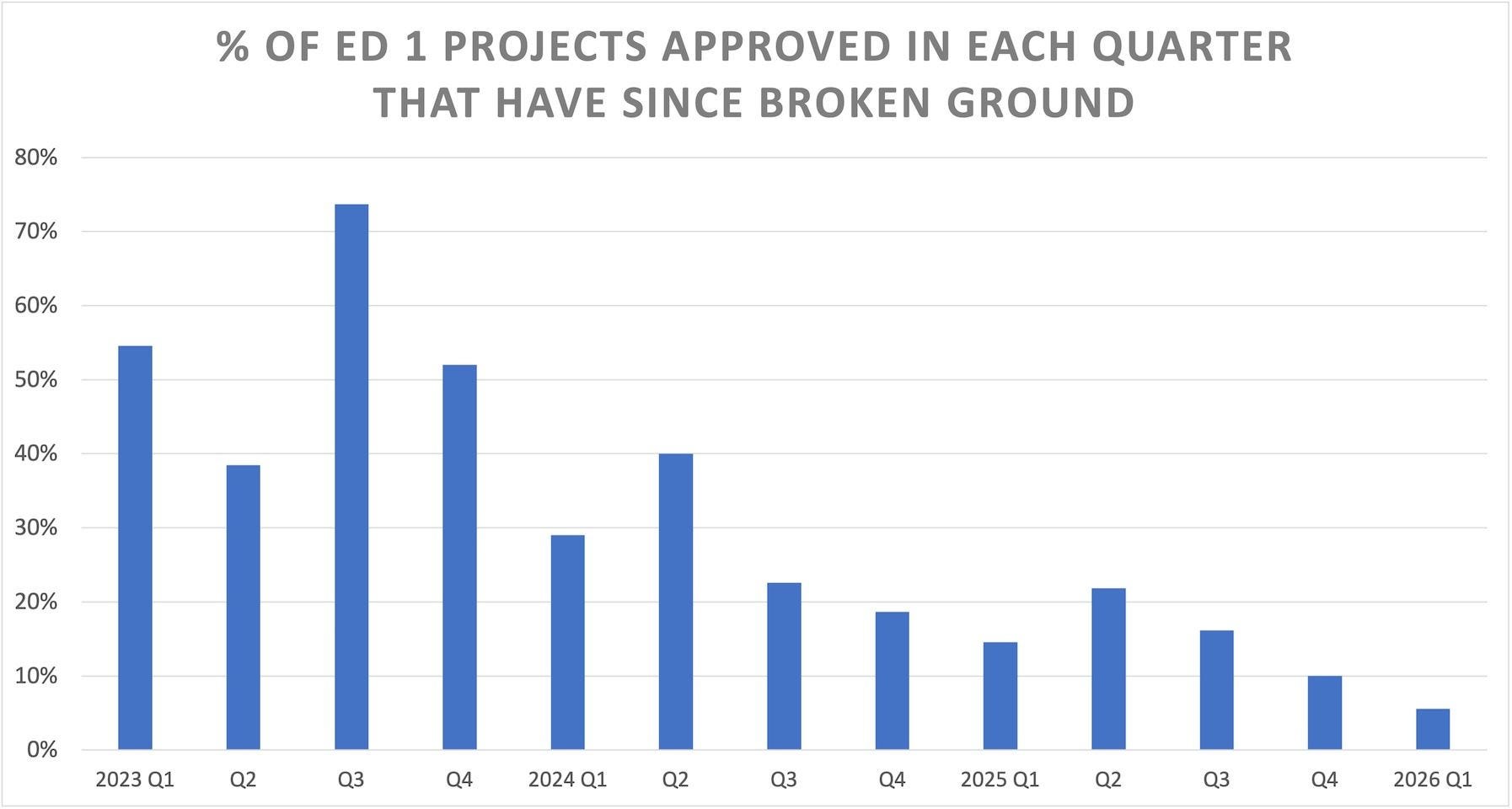
Unless conditions dramatically change, we’re going to start seeing a lot more buildings break ground as they finish plan check. For the graph below, think of all the buildings approved in each quarter as a “cohort”. Each bar represents the percentage of that cohort’s buildings that have broken ground. Buildings approved in 2023 - doing great! 2024 - pulling permits and getting started! 2025 - slogging through plan check. There’s no reason all these cohorts shouldn’t all eventually get to over 50%.
One more graph to convince you ED 1 construction is just getting going:
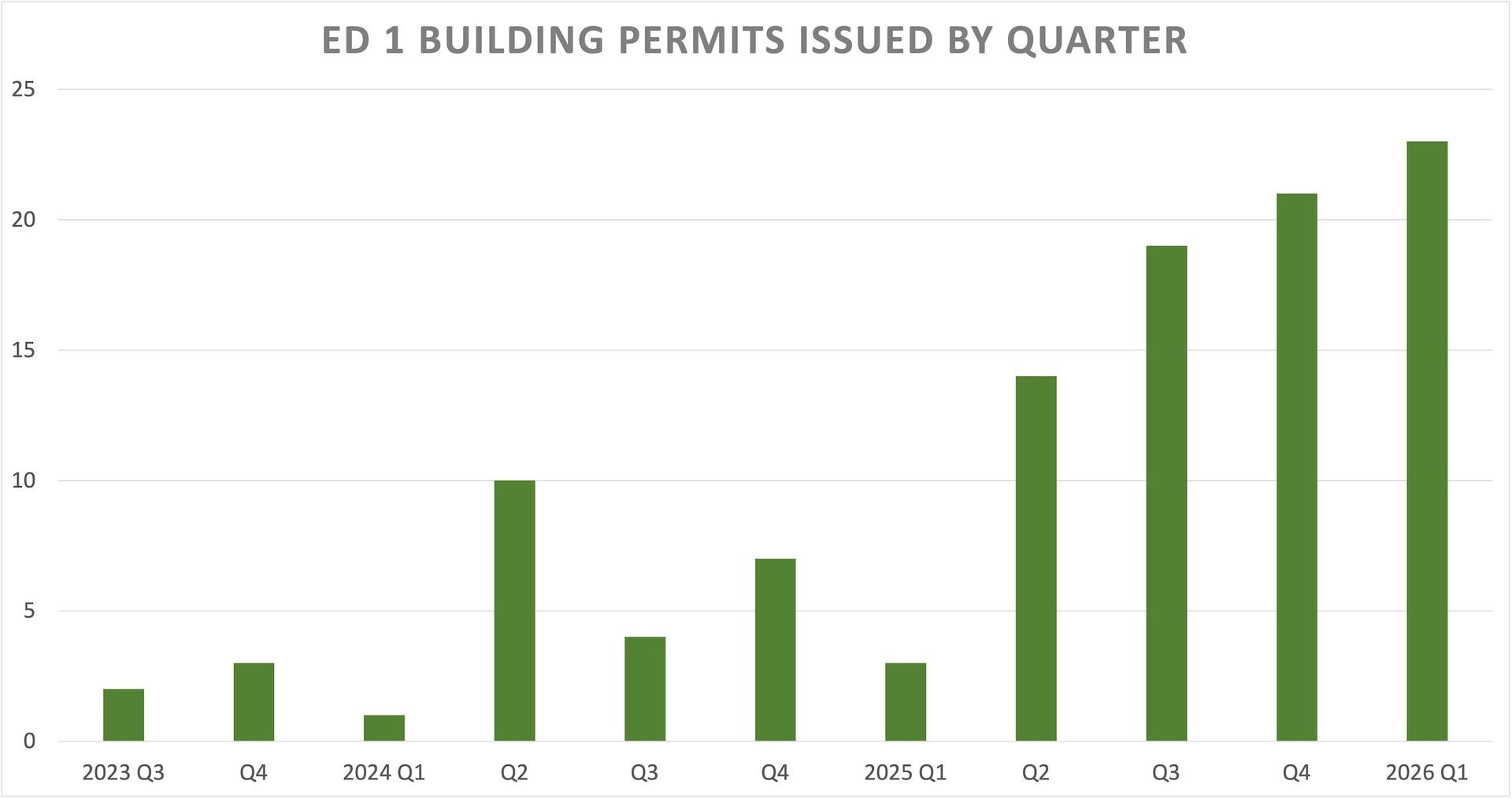
By the way, this mini-glut of ED 1 buildings comes at a time when construction is down significantly in LA overall. Last year, less than 8,000 apartments broke ground in the entire city, down by about a third from before the pandemic. And yet the numbers would have been a lot worse if not for ED 1 - a majority of the total apartments that broke ground in LA last year were in ED 1 buildings.
And just so you know, none of this data includes Sky Village Hollywood, which hasn’t actually gotten its building permit yet. When it does, 523 apartments will be added to the total.
ED 1 buildings can be beautiful
Quick story: I’ve been advocating to strengthen ED 1 almost since the beginning, including co-writing an op-ed on the subject in late 2023. After that piece was published, my co-authors and I met with the office of a certain City Councilmember. A staffer pushed back on our advocacy, telling us ED 1 buildings look like “jails” and that their constituents don’t want those ugly buildings in their neighborhoods.
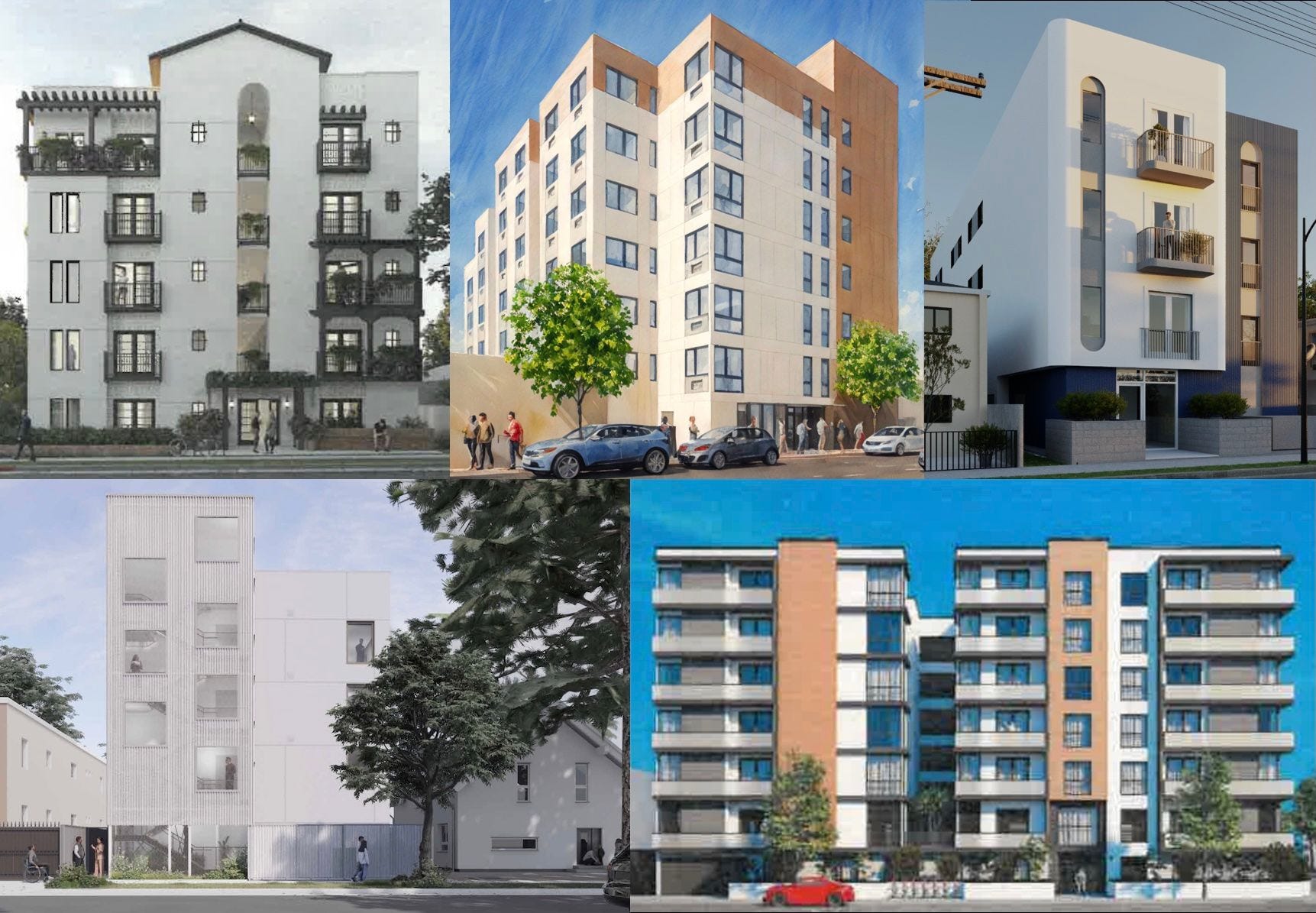
The only way to build affordable housing without taxpayer help is to build cheaply, and it’s true that cheap construction is often ugly. Some of the renderings in proposed ED 1 buildings are pretty bad. But plenty are lovely! Check out these ED 1 projects, all under construction, all privately funded:
ED 1 projects are being built all over the city
This one’s a bit inside-baseball but important for me to address. In 2024, some at City Hall started raising concerns that too many ED 1 projects were being proposed in lower-income neighborhoods. ATC Research, a service that provides land use data in LA, reported that 49% of approved ED 1 projects were located in South LA. This is an equity issue - it would be kind of gross if we mostly put new homes for lower-income folks next to other lower-income folks. There was talk of capping the number of projects that could be approved in each city council district until every district reached the cap.
In the end, the concerns turned out to be overblown. Many of the proposed South LA projects weren’t actually financially feasible and didn’t get built. I’ve mapped the 118 ED 1 buildings that have broken ground, and as you can see, they are pretty well-distributed throughout the city (the Valley has plenty of projects too - they are on the full map). Completed buildings are in green.
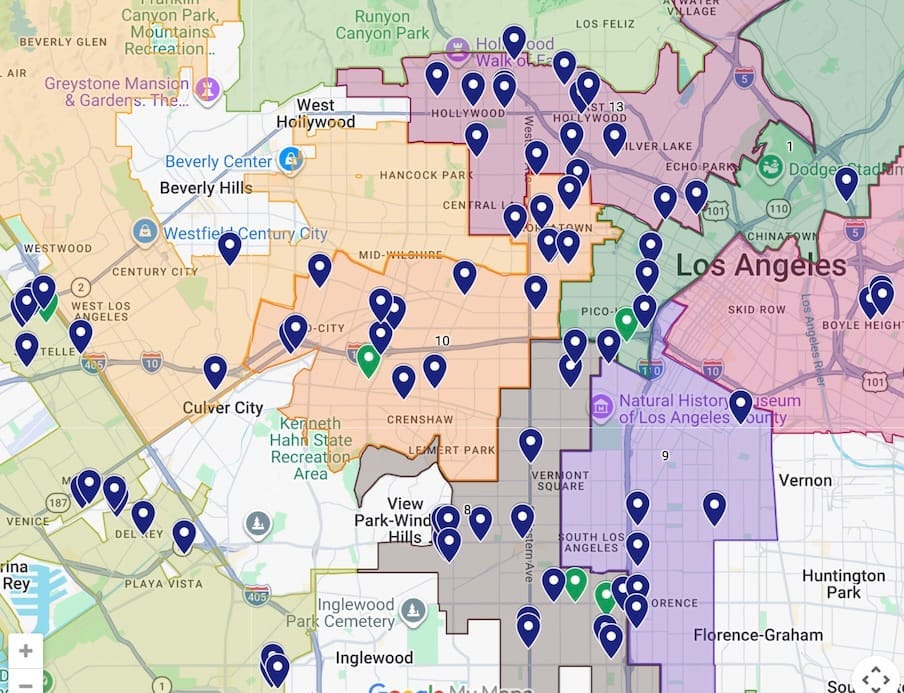
Still, a third of projects that have broken ground are in South LA,3 which is too many for my taste - I’d like to see more affordable housing built in affluent neighborhoods that have historically been off limits to lower-income Angelenos. The simplest way to do that would be to allow ED 1 to be used in single family neighborhoods, which tend to be in wealthier parts of town. And that brings me to…
The Mayor didn’t kill ED 1
In the first few months after ED 1 was issued, a handful of projects were proposed on large lots in the Valley that happened to be zoned for one single-family home. After the requisite neighborhood freakouts, Mayor Bass revised her order to explicitly ban its use in single-family neighborhoods, saying the program was never intended to apply there. Housing activists proceeded to freak out, and banning single-family from ED 1 is still often the first sin they bring up when complaining about the mayor.
The part many folks don’t get is that ED 1 couldn’t be used on the vast majority of single-family properties even before the mayor issued her revision. To use ED 1, projects have to qualify for the state density bonus, which requires a property to be zoned for at least five homes. The projects in question were unicorns - they were located on lots so big (over 25,000 sq. ft.) that the city allows five homes there under its obscure definition of single-family zoning, which actually allows one home per 5,000 sq. ft. of land.
All the Mayor’s revision did was ban ED 1 from being used on the tiny fraction of single-family lots bigger than 25,000 sq. ft. Did this change kill the program? Absolutely not:
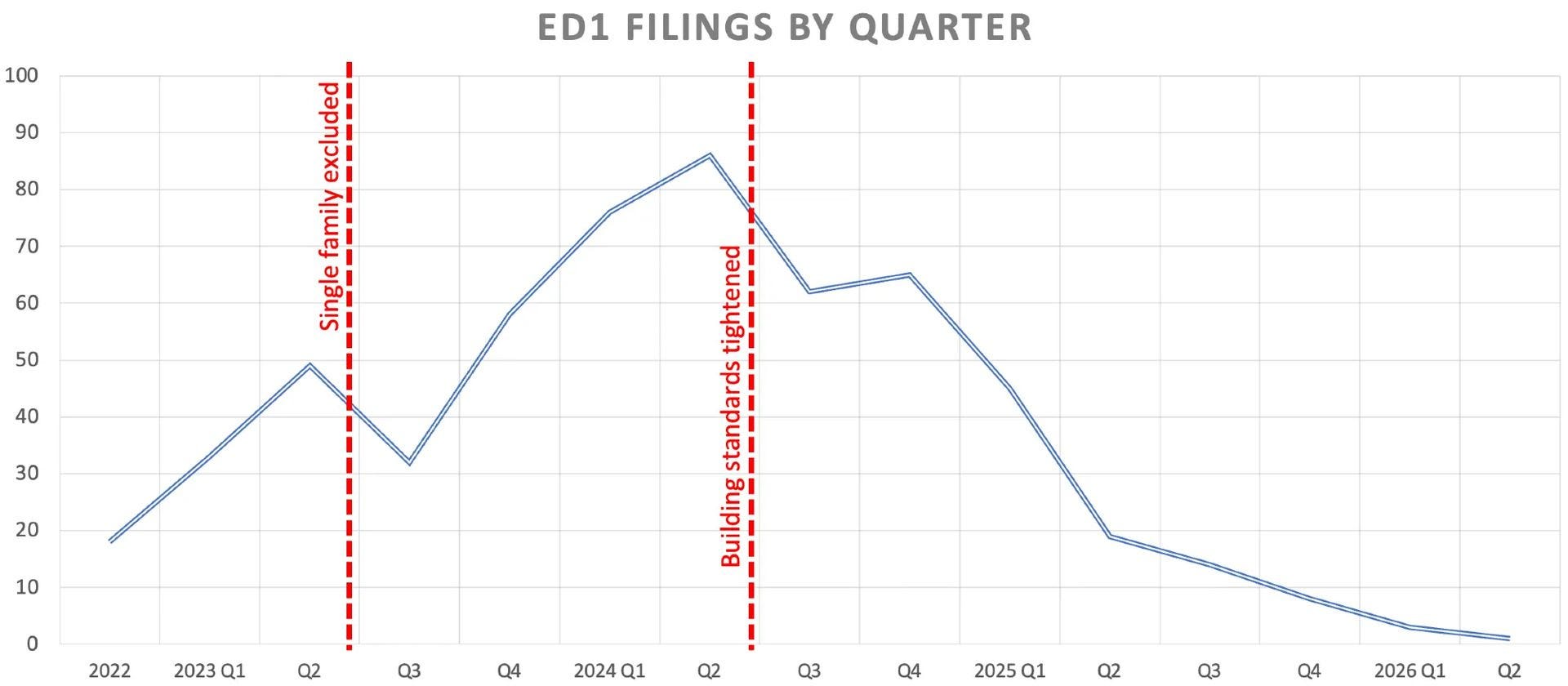
ED 1 applications did begin a major decline after the Mayor’s second round of revisions, in June 2024, that introduced new design standards and other restrictions to appease NIMBYs and assert more control over how the buildings look. This controlling strategy has been used over and over again in LA, and somehow the city never learns that it always kills project feasibility. In the first half of 2024, ED 1 was absolutely crushing it, with builders filing an average of 27 projects per month. Almost every day brought a new ED 1 application. But the decline was swift after the Mayor tightened the program.
According to an Abundant Housing report on ED 1 written soon after the Mayor’s revisions were published, the most impactful new rules were ones that made buildings smaller. 69% of projects proposed before July 2024 couldn’t comply with the revisions’ requirements for bigger setbacks, and 54% couldn’t provide as much open space as required by the revisions. Once the Mayor’s changes went into effect, it’s possible that builders had trouble making smaller buildings work and stopped proposing them.
But I don’t think those revisions killed the program either, and here’s why. ED 1 grew up last year, evolving into the Affordable Housing Incentive Program, which is just about the only part of CHIP that is generating any proposals for new homes. (Technically ED 1 lives on as a separate program from AHIP, but it’s rarely used on its own any more.) The interesting part is that AHIP undid most of the restrictions the Mayor added in July 2024. If those restrictions had been killing feasbility, AHIP would have unlocked a bunch of new building proposals. Are the applications pouring in? Not really:
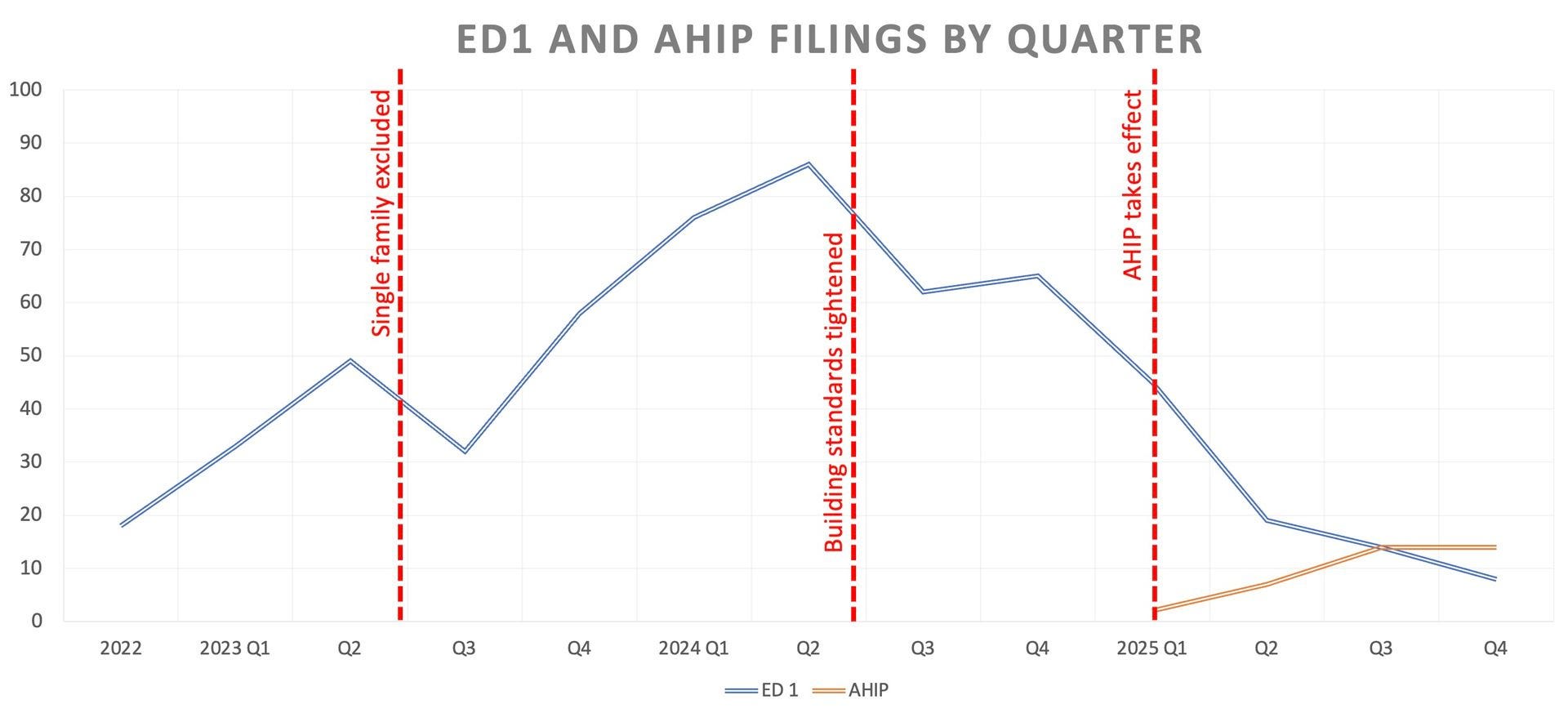
It’s too early to know what’s going on here. Perhaps developers are still figuring out AHIP, and applications will start coming in a faster clip soon. Perhaps external factors are to blame, like the federal government’s 2025 reduction in the value of Section 8 vouchers in lower income neighborhoods, which many ED 1 developers count on getting. Perhaps ED 1 was a bit of a bubble, and we are headed toward a more natural equilibrium. No matter what, I’m not going to blame Karen Bass for it.
The way forward
Remember Proposition HHH? That’s the ballot measure we passed in 2016 to use our tax dollars to build 8,000 affordable homes to the tune of $1.2 billion. ED 1 has already gotten almost as many affordable homes built at zero taxpayer cost.4 It is an absolute godsend to the City of LA, and we should be finding ways to strengthen its successor AHIP as much as possible.
Start with allowing AHIP in single-family neighborhoods. A recent motion from Councilmember Ysabel Jurado would instruct the Planning Dept. to figure out how to add AHIP to the recently enacted Low Rise ordinance that upzones single-family areas around SB 79 areas. That’s a good start, but let’s go farther and allow AHIP in single-family neighborhoods near all transit, including bus routes that don’t qualify for SB 79.
We also need to speed up the plan check process. It shouldn’t take almost two years to get permission to start building. The added time and uncertainty of the permitting process adds risk for developers, making it harder for them to get funding for their projects.
LA should be proud of ED 1. We sort of accidentally spawned a whole new industry of for-profit affordable housing builders, and we should nurture it. We can be the national model for how to build affordable housing at scale through the private sector. And we can build a city where even regular people can afford to live.
I used the list of projects on the city’s ED 1 dashboard and added several more projects found by ATC. I consolidated multiple applications for the same address, removed SRO remodels, and removed projects that only used ED 1 to bypass redevelopment area approvals. Raw data is here.
I looked at all 5+ unit buildings in the city’s 2023 Housing Element Annual Progress Report and cross-referenced with my list of approved ED 1 projects, adding a few missing projects picked up by ATC. Raw data is here.
This includes the areas the Planning Dept. calls South LA, Southeast LA, and West Adams-Baldwin Hills-Leimert Park.
Of ED 1 projects that have broken ground, 6211 apartments are privately funded, and 2308 have received some sort of public subsidy.