



I never thought I’d become an expert on Los Angeles playgrounds. But a few years ago, with two fidgety little kids, I became a walking playground Tripadvisor. Name a brunch restaurant, and I could tell you the closest park to take the kids to play after we ate. Name a playground, and I could tell you whether its floor was sand (wear sandals) or rubber (wear whatever).
I learned so much about playgrounds in other neighborhoods because mine has none. Zero public parks or playgrounds within a mile. Every time my kids wanted to play outside, we had to pile into the car and drive to a park in a different area.
A community group I’m involved with decided to try to do something about the lack of public space here. The only available land was a 25-foot-wide strip of sidewalk at the busy intersection of Pico and Hauser. We painted the outlines of flowers on the sidewalk as an invitation for kids to color with chalk. Voila, the Coloring Book:
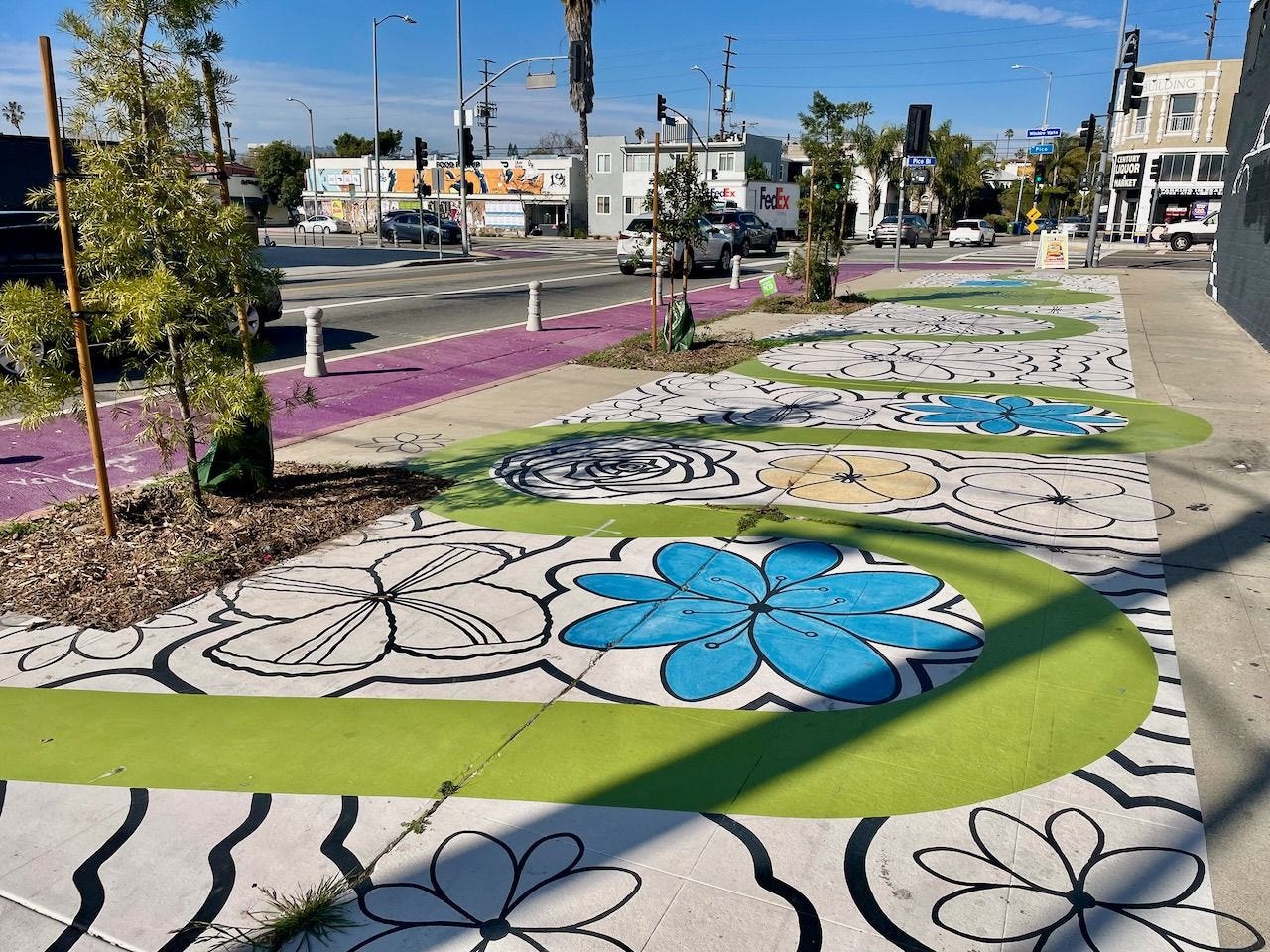
The Coloring Book is pretty, but nobody ever uses it. It just sits there, beckoning and empty. We tried our best, but I can’t say we succeeded in bringing good public space to our neighborhood. Our family still gets in the car when the kids ask to go to a park.
So I took it a little personally when Los Angeles fell to 93rd place in the Trust for Public Land’s annual ParkScore Rankings of the 100 biggest American cities. Only 62% of Angelenos live within walking distance of a park, compared to 99% of New Yorkers and 100% of San Franciscans. LA was ranked 55th out of 100 just seven years ago, but we’ve been lapped by other cities that have been adding more parks, while LA has essentially stopped. The Coloring Book notwithstanding.
Our dismal park ranking has been on my mind this summer as SB 79 took effect, allowing apartments to be built within a half-mile radius around transit stations. LA has 145 qualifying stations, each of which could eventually welcome tens of thousands of new people to the area around it - people who will need amenities like parks.
It’s wonderful that SB 79 allows apartment buildings around our best transit. But people don’t just live in buildings. They live in neighborhoods. How can the city plan 145 neighborhoods that help their residents thrive? For parks, the path forward is revealed by SB 79 itself.
How to buy the land for parks
The biggest hurdle to creating new parks in LA is getting the land. Land is expensive here and rarely vacant. But SB 79 provides two opportunities that could make that process easier - one geographical, and one financial.
Last year, the city produced an amazing park needs assessment that prioritizes which areas should get new park space first. Almost all are in low-income neighborhoods. And remarkably, almost all have good transit and were upzoned this year by SB 79. Maybe I shouldn’t be surprised that in LA, poor people get transit, and rich people get parks.
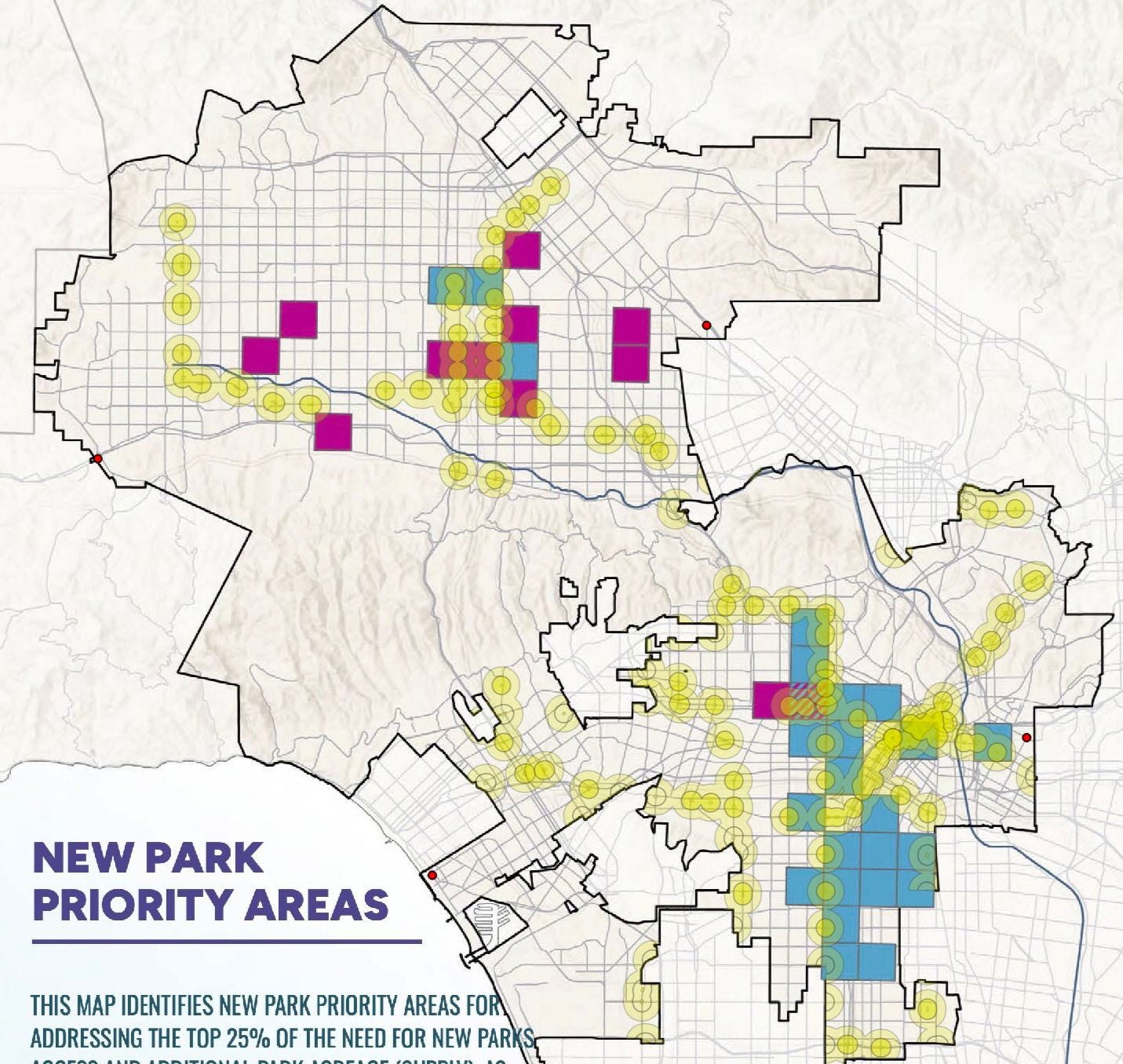
Of the 36 blue and magenta park-poor squares on the map, 30 of them overlap with yellow SB 79 station areas. That overlap creates an opportunity. The city can leverage a quirk in SB 79 to buy land for parks in those places.
The quirk: LA was able to delay SB 79 from taking effect in almost all the park-poor squares because they are also primarily low-income. Nothing has been upzoned in those neighborhoods yet. The city has until 2031 to finalize the area's zoning, and it has some flexibility in deciding how much density goes where. That means for now, landowners don’t know how much their property will be upzoned, so the value of their land hasn’t gone up as much as it will in a few years.
That creates some urgency. It would behoove the city to buy the land for parks in those yellow SB 79 areas before 2031, when prices will likely go up.
Here’s where LA could get creative. The flexibility in the final SB 79 zoning gives the city a tool to make buying the land even cheaper. If an owner agrees to sell their land for a park, the city could partially fund the purchase by letting them sell their final SB 79 zoning to another landowner in the area. If the final plan allowed six-story buildings on their property, the owner could sell three stories of zoning to another property owner, who would then have the right to build three stories taller on their land. This is known as “transfer of development rights (TDR),” and it’s already legal in downtown LA. The city would only be on the hook for the remainder of the sale price.
To supercharge TDR in the lower-income areas that need parks, the city could allow property owners to sell their development rights to an owner in a more affluent part of town, like the Westside. The rights are more valuable in places where rents are higher and developers can make a bigger profit. SB 79 allows density to be moved around somewhat between station areas in the final plan, as long as the net gain remains the same. More housing should be built in our wealthy neighborhoods anyway - to get a park in South LA, sell development rights to Cheviot Hills!
TDR probably wouldn’t generate enough money to fully fund all pre-2031 land purchases. The city would have to cobble the rest together with the scant funds it already has. LA does collect about $50 million annually in park fees on new development, but currently all of it goes toward refurbishing existing park facilities. If we redirected half of that toward buying land for new parks for the next few years, we could make a huge down payment on greening our most park-poor neighborhoods.
How to build the parks
So far, we’ve just covered a possible scenario for getting the land for parks. But building parks requires a whole lot of funding too, and we can’t keep dipping into park fees, especially with a $2.7 billion maintenance backlog for our existing parks. We need a different funding source.
The state recently created a tool that could unlock a decades-long funding stream for neighborhood upgrades like parks. When a neighborhood gets upzoned, the city knows it will collect more property taxes there: first, the upzoning will make everybody’s land worth more, and second, new buildings will be built that raise their property’s value even more. The tool allows the city to set aside the future tax revenue to build infrastructure in the area.
This tool is known as an Enhanced Infrastructure Financing District (EIFD), and it’s been used most successfully in West Sacramento, a small city across the river from our state capital. West Sacramento is using an EIFD to transform its formerly industrial waterfront into a bustling mixed-use neighborhood.
EIFDs take several years to set up, and even once they are up and running, they don’t generate much revenue for the first few years. That’s why we need to use park fees or some other funding source to start buying land for the parks before 2031, when the land costs less. But once the EIFD gets going, it can provide a tremendous amount of revenue to fund the investments the city should be making in its historically neglected neighborhoods.
My vote for an EIFD: four South LA stops on the planned Vermont Bus Rapid Transit line, from Vernon to Manchester. The area is one of the most park-poor in the entire city, and there are tons of single-family homes in the area that could be demolished without displacing tenants.
You might be thinking, this is all pretty convoluted. Why not just require developers to set aside some of their land for open space? In fact, we do! The city calls them “privately owned public spaces,” and they are a poor substitute for actual public parks. The closest playground to my house is one of those spaces, a tiny, gated spot behind the Wilshire Courtyard office complex. The security guard with the key sits behind the reception desk in one of the big office buildings. Good luck getting him to walk over and unlock the playground gate on a rainy day.
The big picture
Beyond parks, EIFDs can be used to fund all kinds of upgrades to a neighborhood, such as:
Infrastructure like water, sewage, and power
Bus and bike lanes
Libraries
Childcare centers
Mixed-use developments to bring anchor retail like grocery stores
That makes an EIFD the perfect vehicle for more holistically planning our new SB 79 neighborhoods. But not all 145. If an EIFD takes up too much of a city’s land, it risks cannibalizing the overall property tax revenues the city depends on for its budget.
So how do we actually build 145 new parks in LA? I don’t know. The more important issue is: are we even asking the question? Is the city thinking about how to holistically plan the 145 SB 79 neighborhoods?
LA has already changed some zoning in response to SB 79, creating a program called Low Rise that slightly upzones residential streets around transit stations in wealthier neighborhoods. Low Rise is overly controlling and cautious, allowing only 3-4 story buildings with all kinds of restrictions. The theory is that incremental development is less likely to lead to a backlash from neighbors. But we can’t do both incremental and holistic - they are enemies. When we prioritize appeasing neighbors’ anxiety about change, we think of change in terms of how little damage it can cause. When we prioritize holistic planning, we think of change in terms of how much good it can create.
What if instead of planning for the least harmful incremental change, we envisioned the best final product? Vibrant neighborhoods with parks, infrastructure, and amenities that make them great places to live.
The city has all kinds of plans that guide long-term planning, like the Mobility Plan and the new Capital Improvement Plan. We can start envisioning great SB 79 neighborhoods by updating our existing citywide plans to account for future growth there. It shouldn’t have been a coincidence that the park needs assessment identified SB 79 station areas as the highest need - the assessment should have been driven in part by the growth SB 79 will create.
I don’t know how to plan 145 new parks in SB 79 areas. But the city owes it to us to figure it out.
It’s a shift in mentality, from planning cautiously to envisioning holistically. From short-term thinking to generational thinking. From placating current residents to nurturing future ones. Either way, a generation from now, hundreds of thousands of new families are going to be raising their kids in SB 79 neighborhoods. Nobody will remember the old complaints from neighbors. But everybody will benefit from the investments the city boldly decided to make.