

Would you drive or take the train?
Progress often doesn’t happen until a bunch of people decide to really care about making it happen. Recently I was lucky to join a group of committed volunteers who did just that.
The E Line is one of the most useful and popular transit lines in the city, connecting downtown to the beach and East LA. But it’s slow. Even before it opened, the LA Times’ Kerry Cavanaugh wondered if the train was “doomed to slow, mediocre service.” She noted that trains close to downtown were often forced to stop at traffic lights, which made the 15-mile ride from DTLA to Santa Monica take 46 minutes.
LADOT knew traffic lights were problematic from the start. Shortly after the line opened, an LADOT engineer admitted that “there are times when the train has to stop briefly, or not so briefly”. If you’re not an E Line rider, you can experience some of the not so briefly in this amazing Youtube video where an anonymous cyclist rides down Exposition Blvd., obeys all traffic laws, and has no trouble keeping up with a train.
Why is the E Line so slow? The main reason is that first phase of the line, between downtown and Culver City, was built on the cheap. This was before voters gave Metro billions of additional sales tax dollars through Measure R (in 2008) and Measure M (in 2016). On a tight budget, Metro built the tracks and most stations “at grade”, not elevated or underground, especially east of Western Ave. Trains have to cross intersections like all other traffic. The second phase of the line to the beach was built with Measure R funds and is almost completely grade-separated, with elevated stations. This map of Metro light rail crossings shows the stark difference east and west of Western - blue means grade separated or gated, and orange means at grade and not gated.

East of Western, the train hits lots of traffic lights (orange dots). West of western, intersections have railroad crossing gates (blue dots). Full map here.
The slowness of the train creates tough decisions for riders. Imagine you need to get from DTLA to Exposition and Western on a weekday morning. Google Maps says driving is faster than the taking the E Line (first image). But starting from Expo/Western and going farther west to Culver City, Google Maps says the train beats driving (second image).

DTLA to Expo/Western: driving is faster, biking almost is too

Expo/Western to Culver City: train is faster
You’d think the stark difference east and west of Western, plus ten years of rider complaints, would have spurred some action by LADOT, which owns the signals, or Metro, which owns the tracks. In fact, transit is slow just about everywhere it has to deal with LADOT’s signals, including the A Line on Washington and the K Line through Hyde Park. Solving this problem would have broad benefits.
Even elected officials have made occasional gestures toward speeding things up over the years. In 2019, City Council passed a motion by Mike Bonin leading to signal timing tweaks that cut E Line travel times by 1-2 minutes. In 2023, Mayor Bass rode the E Line when the 10 Freeway downtown closed due to a fire and asked Metro to work with LADOT to speed it up, with no results. In April 2025, Council passed a broader motion by Nithya Raman asking LADOT for a report on options for prioritizing light rail and buses across the city that led to nothing by the beginning of 2026.
In the end, very little has changed in ten years. Remember Kerry Cavanaugh fretting that E Line from downtown to the beach would take 46 minutes? According to Metro’s schedule, ten years later it’s 47 minutes. Ten years of a stubborn status quo, immune even to interventions from LA’s highest elected officials.
That’s where our story really begins.
#proj-signal-preemption
In January, volunteer Bobby Garrity posted a question on the Streets For All Slack (which I participate in). Garrity lives downtown and works in Santa Monica, and as a daily E Line rider he was fed up with the slow train and looking to do something about it. He asked if other volunteers were interested in forming a group to push for change. After getting an enthusiastic response from people frustrated with the city’s lack of action, Garrity formed a working group, and we organized ourselves into three teams - Technical, Content and Outreach, and Political.
The group’s efforts got a shot in the arm in February when LADOT finally submitted the report requested by Nithya Raman’s 2025 motion. Disappointingly but not surprisingly, the report mostly just described the current slow state of affairs for prioritizing transit in LA. Signals can shorten a red light or lengthen a green a bit to give a train or bus priority. For light rail, signals are also automatically kept green in the train’s direction as long as no cars show up on the cross street, which helps a bit for minor intersections. At the end of the report, LADOT threw in a few vague paragraphs about exploring stronger options without committing to anything. They recommended that Council “note and file” the report, which is city-speak for “do nothing”. More stubborn status quo.
By this time, our Technical team already knew what the stronger options were, plus what software or hardware changes would be needed to implement them. They had spoken with engineers at LADOT, Metro, and private transportation engineering companies. They had submitted public records requests for Metro data on light rail speeds. Connor Webb had even written a glossary of the confusing jargon around transit signal prioritization so the rest of us volunteers understood what the heck they were talking about.
Once the LADOT report came out, the other two teams got going. For Content and Outreach, Jonny Hale made a viral Instagram video about trains stuck at red lights:
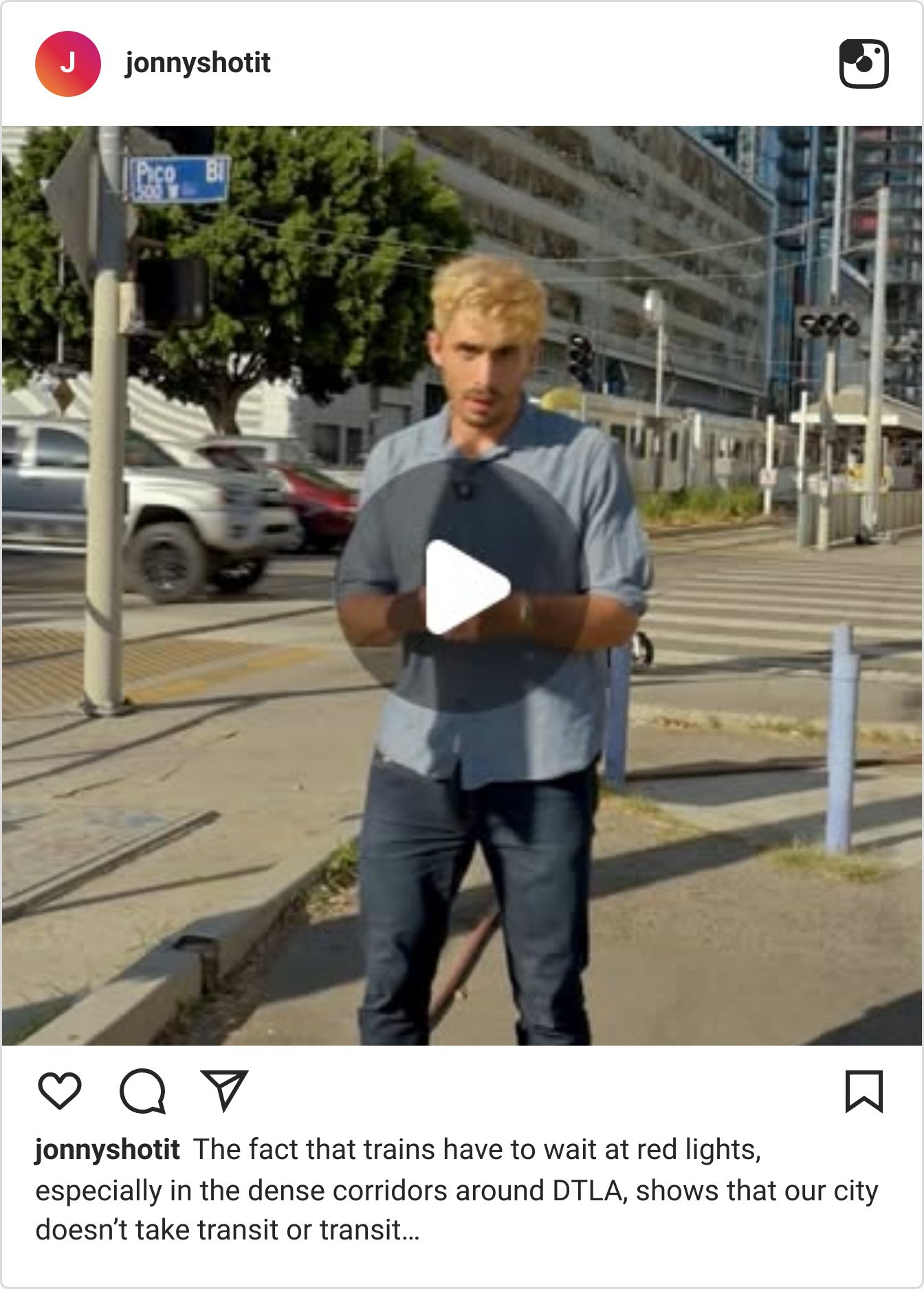
Over on Reddit, Colin Warn (aka u/DJVeaux of “Ride the D” t-shirt fame) posted a call to action called “If You’re Tired Of Your Train Stopping At Intersections, An Opportunity To Advocate For Fixing That”. Jonny and Colin’s posts inspired people to submit over 450 written comments to City Council imploring them to speed up transit.
For the Political team, I reached out to staff of Councilwoman Heather Hutt, chair of the Transportation Committee, which would be taking up LADOT’s report. Hutt’s staff told us she too was disappointed with the report and delayed her committee’s consideration of it to figure out what could be done. We made it our mission to convince the Councilwoman to issue a strong recommendation instead of “note and file”. We also decided to focus on the E Line, the most prominent transit line in Hutt’s district.
What we learned
In response to a public records request, Metro sent us a revealing report on the E Line prepared by Turner Engineering in late 2021. Turner found that east of Western, trains wait more time at red lights (red bars in the image below) than they do at stations (orange bars). In total, trains stop at red lights for almost 5 minutes.

E Line delays at every intersection. East of Western, trains wait longer at signals than at stations.
All those red lights make the E Line unpredictable. It averages 47 minutes from the beach to downtown but can take up to 57. Check out the long tail stretching to the right in the graph below, which shows the actual time it took various trains to get from Santa Monica to DTLA. Riders have to plan for the worst to make sure they are on time, which means they need to set aside nearly an hour to go east during morning rush.

Actual travel times for E Line trains range from 41-57 minutes.
Some intersections are simply brutal. Westbound trains have to stop at Vermont almost 90% of the time, with the station platform beckoning just past the red light. Trains in both directions stop at Washington and Flower, where the E and A Lines meet, over 80% of the time, for almost an entire minute on average.
Even more embarrassingly, trains stop pretty frequently at some very minor intersections, like Expo/Halldale - 27% of the time westbound in the afternoon, for a side street that carries a few hundred cars every day, slowing down 20,000 daily E Line riders.
The most enticing tidbit of the Turner report came in the conclusion. When transit is sped up, it also becomes cheaper to run, because you provide the same service in fewer hours. Turner calculated that if red light delays on the E Line were reduced by just two minutes, Metro would save so much money that it could add another train to the line at no additional operating cost. Another train means the E Line would come more frequently. For free.
What can be done?
A lot! Here are just some of the interventions LADOT and Metro could make to prevent transit from stopping at red lights.
Grade separation: The best way to speed up the E Line, and also the most expensive. In 2017, Metro estimated it would cost almost $1 billion. So…next?
Railroad gates: The next best option, though also not cheap. Many E Line intersections west of Western are gated, including major streets like Arlington Ave. and Westwood Blvd.
If you check out Google Streetview east of Western from 2007, before the E Line was built, you’ll see old tracks that were used for freight until the 1980’s. And - surprise! - many intersections have railroad signals:


Freight trains got higher priority decades ago than the E Line, carrying tens of thousands of daily passengers, gets today!
Changing traffic patterns: 12th St. is a little one-way street downtown where one out of every six A and E Line trains have to stop at a red light. The city has proposed closing the block of 12th just east of Flower so drivers can’t turn onto 12th across the tracks, as the white car is doing in this Google Street View image. Closing 12th will allow the train to get the green every time, except when pedestrians need to cross Flower. Closures or turn restrictions are possible at a bunch of E Line intersections (looking at you, Watt Way) - it just takes political will.
Signal preemption: Traffic lights can be programmed to automatically turn green when a train approaches. Unfortunately, LADOT told us preemption is not legal in California without gates.
Upgrading signal controllers: Probably the best bang for our buck. You know how LA became famous for inventing software to synchronize signals for the 1984 Olympics? Well, what was once cutting edge has become vintage - our traffic lights are still using that same 1984 hardware and software. Newer signal controllers like D4 are designed for smoothing the flow of transit, not just cars. They can do many tricks to prioritize transit that LA’s controllers can’t do, such as “phase reservicing” - re-ordering the sequence of green lights and turn arrows so the train gets the green next.
Installing D4 in LA would involve upgrading the signal boxes and writing code to get the D4 software to talk to ATSAC, LA’s aging controller software. Luckily, both of those things are happening as part of the ongoing G Line upgrades and should come online some time next year. The success or failure of that project will determine whether transit in the rest of the city can be significantly sped up in the next couple years.
Stronger priority: As it stands now, LA’s signals can shorten a red light or lengthen a green for transit by 10% of the total cycle length, which usually works out to 12 seconds. For the E Line, red lights can’t be shortened much more than that because the streets the train runs on - Exposition and Flower - are quite wide, and pedestrians need to be given time to make their way across the tracks and street. But at minor intersections like Halldale, pedestrians don’t cross very often. As long as the beg button isn’t pressed, the red light could be shortened a lot more for the train (yes, I’m defending beg buttons). This is something LA’s signal controllers can and should be programmed to do right now!
What we accomplished
After doing all this research and organizing, we put together a presentation deck and a more detailed policy memo for Heather Hutt’s office summarizing what we’d learned (check ‘em out - they’re awesome). When we met with Hutt’s staff, we asked them to instruct LADOT and Metro to reduce red light delays on light rail and bus rapid transit by 50% by 2028. And that’s what they did. Their amendment, plus excellent ones from Eunisses Hernandez and Nithya Raman, passed Council last week.
The work is not done. All these amendments do is ask for more reports. But it’s heartening to see an actual policy outcome - a 50% red light delay reduction by January 1, 2028 - written down and passed by City Council. I’m hopeful that in the next year, with continued advocacy and organizing, supported by data and research, we can make real progress on speeding up transit in LA.
